
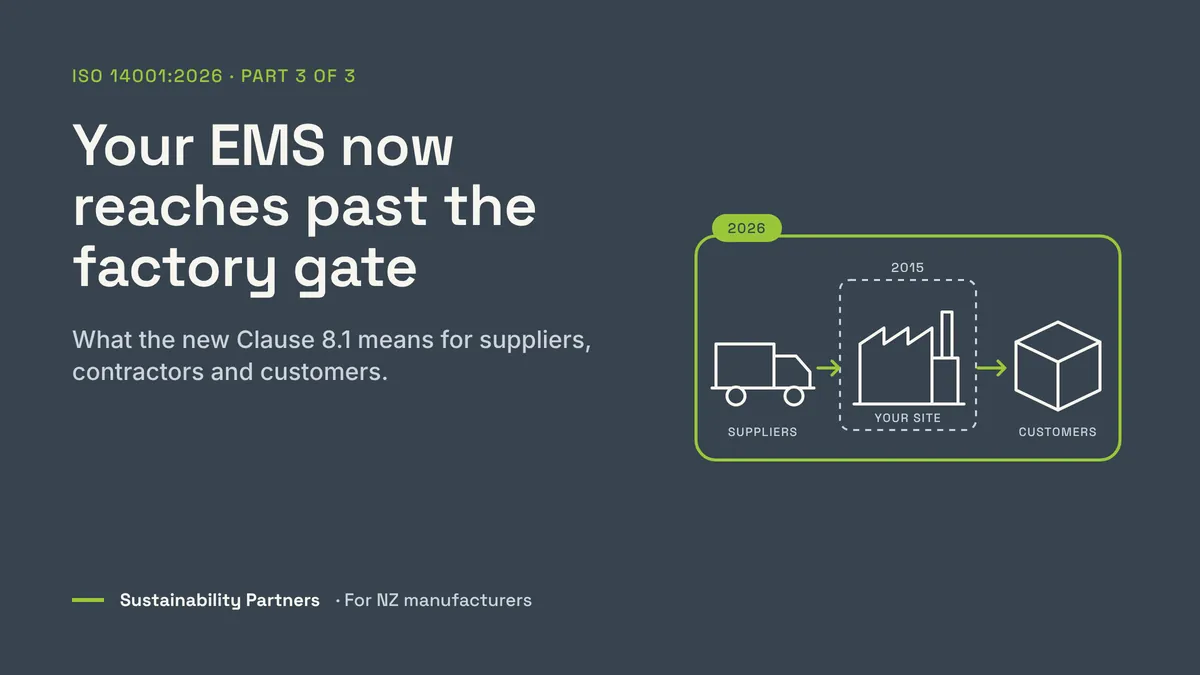
The most practical change in ISO 14001:2026 is a few words in Clause 8.1. The 2015 edition asked you to control "outsourced processes". The 2026 edition asks you to control or influence externally provided processes, products and services that are relevant to your EMS. The definition of "outsource" has been removed altogether.
That sounds like a wording tidy-up. It is not. It moves the boundary of your environmental management system from "work we have handed to someone else" to "anything we bring in that shapes our environmental outcomes". For New Zealand manufacturers, the effect runs in two directions: you will expect more of your suppliers, and your customers will expect more of you.
What the standard now says
Four changes work together.
| Clause | 2015 | 2026 |
|---|---|---|
| 8.1 Operational control | Control or influence over outsourced processes | Control or influence over externally provided processes, products and services relevant to the EMS; documented evidence that these processes are in place |
| 4.3(e) Scope | Consider your authority to control and influence | That authority applies explicitly across the life cycle of your activities, products and services |
| 6.1.2 Aspects | Life-cycle perspective required | A note sets out what a life-cycle perspective should include, from raw materials to end of life |
| 4.2 Interested parties | Identify which requirements become compliance obligations | Clarified: requirements you agree to meet (for example, a customer's supplier code) are compliance obligations |
Taken together, the message is consistent: the supply chain is part of the EMS, not something next to it. (DNV and CQI and IRCA both highlight this shift.)
Who counts as an "external provider" now
Under the 2015 wording, many organisations only listed contractors doing work they would otherwise do themselves. The 2026 wording is broader. Depending on your operation, relevant external providers can include:
- raw material, chemical and packaging suppliers;
- contractors working on site, including maintenance and cleaning;
- waste, recycling and trade waste providers;
- freight, logistics and warehousing;
- energy suppliers, where your choice of energy is a significant aspect;
- designers or engineers whose specifications fix your environmental performance for years.
The test is relevance to your EMS's intended outcomes, not whether a contract says "outsourced".
What it does not mean
There is plenty of overstatement about this change, so it is worth being clear.
- You do not have to audit every supplier. The standard has always let you decide the type and extent of control or influence, and that remains. A low-risk stationery supplier needs no more than it did before.
- Control and influence are different. You can control a contractor on your site. You can usually only influence a multinational resin producer. The standard expects effort in proportion to both your leverage and the environmental significance.
- It is not a Scope 3 reporting requirement. ISO 14001 does not require you to calculate or disclose value-chain emissions. It does require that you consider them where they are relevant, and climate change is now a named condition in Clause 4.1.
A practical approach for buyers
This is the approach we suggest for an SME manufacturer:
- Map your external providers. Start from your accounts payable list. It is the most complete record of who you buy from.
- Rank them by environmental significance. Link each to your aspects register. Which ones affect your waste, emissions, chemicals, water or energy?
- Decide control or influence for each tier. High significance and high leverage: contractual requirements, inductions and checks. High significance, low leverage: specification choices, questionnaires and supplier selection.
- Set and communicate requirements. Build them into purchase orders, contracts, site rules and specifications. A clause in your terms and conditions reaches every supplier at once.
- Keep proportionate evidence. Signed inductions, completed questionnaires, waste transfer records and approved supplier lists are the documented information an auditor will look for under 8.1.
- Link it to change management. Under the new Clause 6.3, a change of key supplier or material is a change that could affect the EMS. Assess it before you make it.
What it means if you are the supplier
If you sell to larger companies or into export markets, expect environmental questions in tenders and supplier reviews to become more frequent and more specific. Your certified customers now have a clear clause pushing them to ask.
That can work in your favour. A supplier who can answer quickly with real information, such as an emissions estimate for a product, a waste profile or a credible transition plan, is easier to buy from. Under the revised Clause 4.2, when you agree to meet a customer's environmental requirements, those commitments also become compliance obligations within your own EMS. Track what you have agreed to.
For businesses still running process heat on reticulated gas, customer questions about emissions and energy supply are likely to come up sooner rather than later. Having a dated transition plan is a stronger answer than having none. Our article on why your bank is about to ask for your carbon numbers covers the same pressure from lenders.
Don't forget emergencies
Clause 8.2 on emergency preparedness should be reviewed in the same light. A chemical spill by a delivery driver on your site, a waste contractor failing, or a key supplier being shut down are all scenarios where you may have control or influence. Consider whether they belong in your emergency planning.
The bottom line
ISO 14001:2026 does not ask you to manage your suppliers' environmental systems for them. It asks you to know which external providers matter, decide how much control or influence you have, act on it in proportion and keep evidence. Done well, that is also good procurement. For the wider set of changes, see what changed in Clauses 4, 6 and 8 and our five-step transition checklist.
Next step: talk to us about mapping supplier risk, updating your operational controls or preparing for customer questionnaires. Book a 30-minute call and we'll work through where to start.
Information current as of 4 November 2026, based on certification body summaries of ISO 14001:2026. Check requirements against your own copy of the standard.