
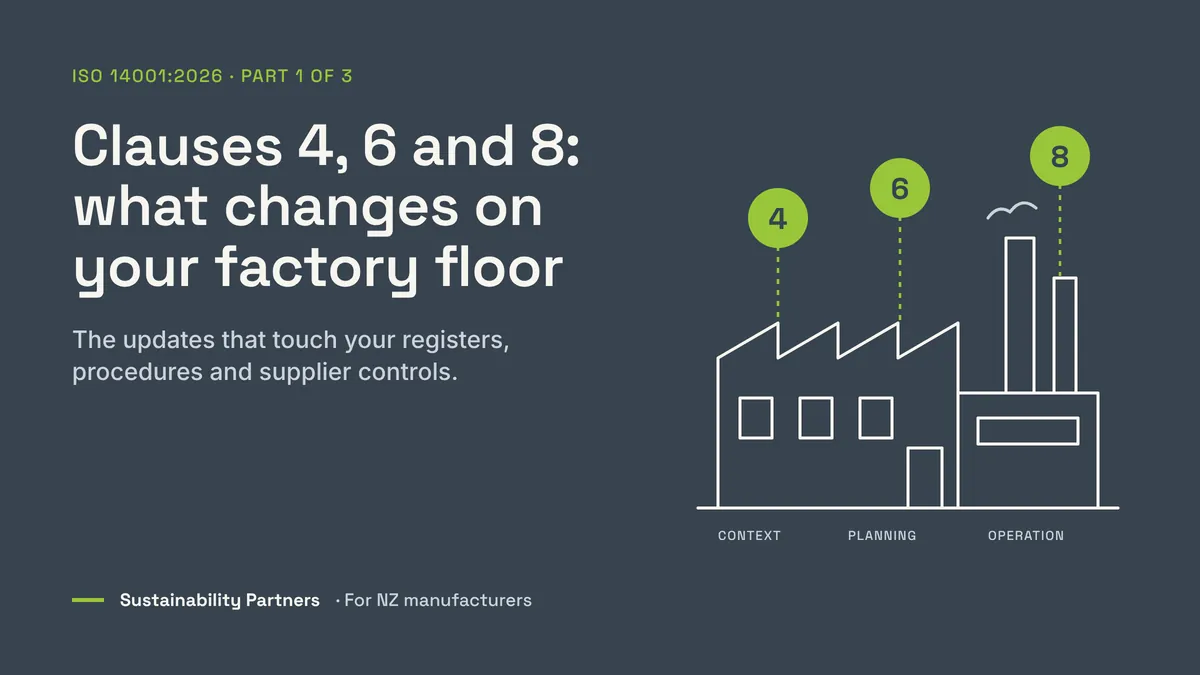
The new edition of ISO 14001 was published on 15 April 2026. It is the first full revision in more than ten years, and it absorbs the 2024 climate change amendment. The good news for certified organisations is that it is a refinement, not a rewrite: certification bodies such as DNV describe the changes as moderate.
Moderate does not mean cosmetic, though. Most of what matters sits in three places: Clause 4 (context), Clause 6 (planning) and Clause 8 (operation). Those are where your registers, procedures and supplier controls will need to move. This article walks through each, then summarises the rest of the standard on one page.
Clause 4: context gets specific about the environment
The 2015 edition asked you to consider "environmental conditions" in your context analysis, but left it open what that meant. The 2026 edition spells it out.
4.1 Understanding the organisation and its context. The standard now names examples of environmental conditions to consider as external issues: climate change, pollution levels, biodiversity and ecosystem health, and the availability of natural resources. In practice, a one-line entry saying "climate change: low risk" will no longer satisfy an auditor. You will need to show you have thought about how each condition affects your site, and how your site affects it.
4.2 Interested parties. The needs and expectations of interested parties can relate to those same environmental conditions. The standard also clarifies something that was implied before: once you agree to meet an interested party's requirement, it becomes a compliance obligation inside your EMS. That matters if a major customer has asked you for emissions data or a supplier code of conduct and you have said yes. The term "stakeholder" is now accepted as an alternative to "interested party".
4.3 Scope. Clause 4.3(e) now links your authority to control and influence directly to the life cycle of your activities, products and services. Life-cycle thinking was introduced in 2015. The 2026 wording makes it harder to apply it only to the factory floor.
What to update: your context register, your interested parties register and the reasoning behind your EMS scope.
Clause 6: planning is restructured, and one clause is genuinely new
Clause 6 has the most visible restructuring. Most of it reorganises existing requirements. One part, 6.3, is new.
6.1.1 General is now a short introduction covering processes and documented information for all of Clause 6.1. The detail that used to sit here has moved.
6.1.2 Environmental aspects now requires you to consider aspects under normal conditions, not only abnormal conditions and emergencies. Identification of potential emergency situations has moved here from 6.1.1. A new note explains what a life-cycle perspective should include.
6.1.3 Compliance obligations has only minor wording changes.
6.1.4 Risks and opportunities is a new sub-clause number, but not a new obligation. The risk and opportunity content from the old 6.1.1 now lives here, with clarifications.
6.1.5 Planning action carries forward the old 6.1.4.
6.3 Planning of changes is the only genuinely new requirement. When you identify a change that could affect the EMS, you must plan it: assess the possible effects first, then use that assessment to carry out the change in a controlled way. The aim is to protect the EMS's intended outcomes and avoid unintended environmental impacts.
For a manufacturer, typical triggers include a new production line, a change of raw material or chemical, a new site or building, a restructure, or a switch in energy source. That last one is worth noting for anyone planning to move process heat off reticulated gas: under 6.3, the transition itself should be run as a planned change within the EMS. Our guide to replacing a gas boiler covers the questions to answer first.
What to update: your aspects register (add normal operating conditions and a visible life-cycle view), your risks and opportunities register (re-referenced to 6.1.4), and a new management-of-change procedure or form for 6.3.
Clause 8: operational control reaches beyond your gate
8.1 Operational planning and control. The 2015 term "outsourced processes" has gone, along with its definition. In its place is "externally provided processes, products and services" that are relevant to the EMS's intended outcomes. That is a wider population. It can include raw materials, chemicals, packaging, contractors on site, waste and logistics providers, and maintenance services, not only work you have formally outsourced.
Clause 8.1 also now expects documented information as evidence that the operational processes identified are in place. A procedure that lives only in people's heads is now harder to defend.
8.2 Emergency preparedness and response keeps its structure, but should now be read alongside the revised 6.1.2, which is where emergency situations are first identified.
We cover the supply chain implications in ISO 14001:2026 and your supply chain.
What to update: your operational control procedures, your supplier or external provider procedure, and the records that show those controls are working.
The rest of the standard on one page
| Clause | What changed | Effort |
|---|---|---|
| 3 Terms | "Audit" no longer needs to be a documented process; "risk" definition removed; "policy" newly defined; "outsource" definition removed; "indicator" can be quantitative, qualitative or binary | Low |
| 5 Leadership | Policy note adds preservation or conservation of natural resources as an example commitment | Low |
| 7 Support | Documented information wording simplified to being "available" | Low |
| 9.1 Monitoring | You must determine what is analysed, not only measured | Low |
| 9.2 Internal audit | Audit objectives defined; the audit programme itself must be documented | Medium |
| 9.3 Management review | Split into sub-clauses; "outputs" renamed "results"; content largely the same | Low |
| 10 Improvement | Old 10.3 merged into 10.1, now titled "Continual improvement" | Low |
| Annex A | Guidance substantially expanded; old Annex B (2004 to 2015 correlation) removed | Read it |
Sources: CQI and IRCA, Perry Johnson Registrars and TÜV SÜD summaries of the published standard.
What you do not have to change
You do not need to renumber your documents to match the new clauses, rename "records" as "documented information", or retire a manual or a management representative role that works for you. The requirement is that the system meets the standard, not that it mirrors its layout.
Where to start
If you hold ISO 14001:2015 certification, you have until 30 April 2029 to transition, and certification bodies are already booking transition audits. A short gap review against Clauses 4, 6 and 8 will tell you most of what you need to know. Our five-step transition checklist sets out the rest.
Next step: talk to us about updating your EMS for ISO 14001:2026, or building a practical system if you are not yet certified. Book a 30-minute call and we'll work through where your system stands.
Information current as of 4 November 2026, based on certification body summaries of ISO 14001:2026. Check requirements against your own copy of the standard.