
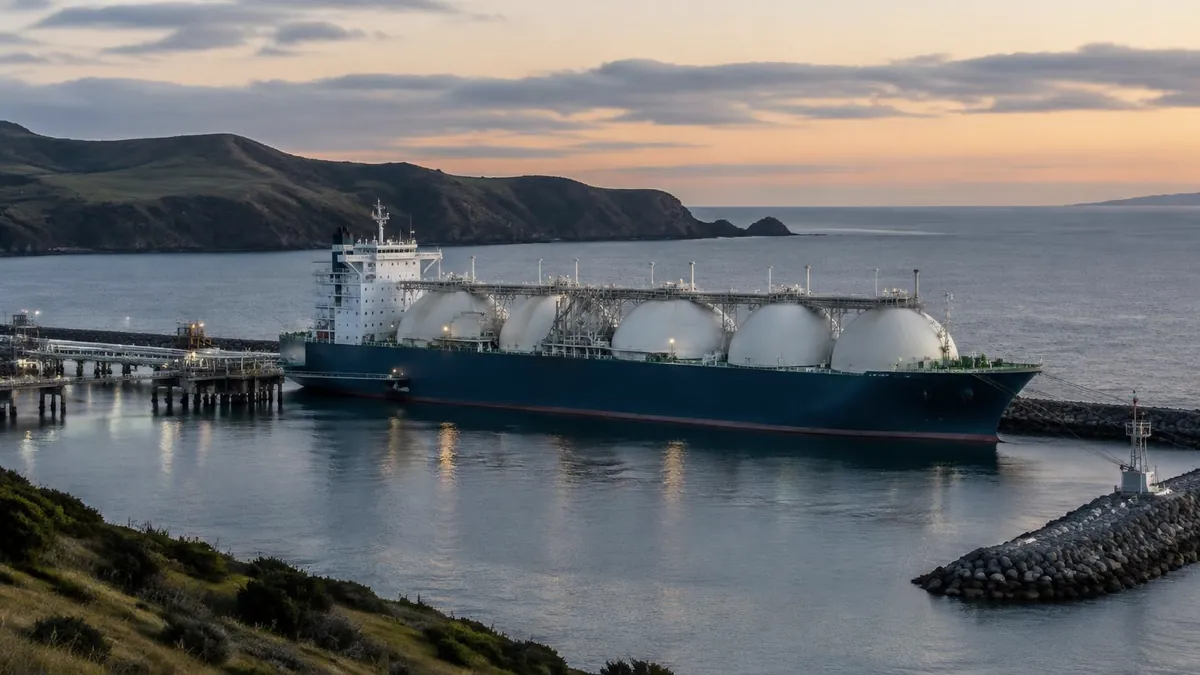
The Government plans to import liquefied natural gas (LNG) for the first time, through a floating terminal at Port Taranaki. For manufacturers weighing whether to move off gas, it raises an obvious question: if gas is coming from overseas, can we just wait? The short answer is no. Here is why, and what the terminal does and doesn't change.
What is being proposed
- What: a floating storage and regasification vessel, moored at Port Taranaki's Main Breakwater, which turns imported LNG back into gas for the network (MBIE).
- Why: mainly as back-up fuel for electricity generation in dry years, when hydro lakes are low, and as a supply for businesses that still depend on gas.
- Cost: indicatively around $1 billion, with an import capacity of about 12 PJ a year (Pipeline & Gas Journal). The funding model is still being worked out; the Government has said it won't be a levy on household power bills.
- When: two bidders were shortlisted and the Government had aimed for the facility to operate from 2028, but the decision is now on hold until after the election.
On hold until after the election
In late September 2026 the decision was put on hold. Coalition partners ACT and NZ First said no contract would be signed before the 7 November general election, and the legislation needed to enable the terminal has not been introduced (RNZ). Labour has not endorsed the project, so whether it goes ahead, and on what terms, now depends on the election result and the coalition talks that follow. The 2028 start date already looks out of reach.
For your business, that adds political risk on top of price and supply risk. A plan that relies on imported gas arriving on a set date is a plan that relies on an election outcome. Reducing your gas use is the one option that doesn't depend on who forms the next government.
The case for
- Fewer electricity price spikes. Dry-year shortages drive the wholesale power prices that flow through to every manufacturer's electricity bill. MBIE says the prospect of LNG has already lowered 2028/29 wholesale electricity futures by about $20/MWh, which it values at around $800 million a year across the economy.
- A safety net for gas users with no alternative. Some processes, especially very high-temperature ones, are hard to electrify. A back-up supply reduces the risk of a sudden shortfall forcing a shutdown.
- Less coal and diesel in a crisis. In a dry year, LNG could replace some of the coal and diesel otherwise burned to keep the lights on.
- Firming for renewables. Reliable back-up fuel can make it easier to build wind and solar without worrying about the rare windless, dry winter.
The case against
- Imported gas means international prices. LNG is priced against global markets. When conflict in the Middle East pushed prices up earlier this year, ministers reportedly reconsidered the project's economics. As University of Auckland economist Basil Sharp puts it, New Zealand "will pay the international price" (University of Auckland).
- A big, long commitment. LNG suppliers typically want contracts of 25 to 30 years with minimum volumes, which sit awkwardly with a facility meant to run only in dry years.
- Scale. About 12 PJ a year is small next to the 85 PJ of domestic production expected in 2026. It can cover shortfalls; it can't replace declining fields.
- Who pays is unresolved. If not households, the cost will land on power companies, gas users or taxpayers, or some mix of them.
- Emissions and lock-in. Critics argue a long-lived gas import facility makes it easier to delay the shift to renewables and electrification.
What it means for your factory
For a manufacturer, the terminal changes the risk, not the direction:
- Supply risk falls. The chance of gas simply running out during a crisis should be lower from 2028.
- Price risk doesn't. Imported gas sets a price linked to international markets, plus shipping and regasification costs. That is unlikely to bring back the cheaper, long-term domestic contracts many sites grew up with.
- Timing doesn't help. Nothing arrives before 2028, while gas contracts are getting shorter and dearer now.
- The funding window is open now. The Gas Transition Loan Guarantee Scheme runs for three years from July 2026, and EECA co-funding for gas users is available today.
The most likely future is gas that is still available but more expensive and more volatile. That strengthens, rather than weakens, the case for using less of it, starting with the low-temperature heat that is easiest to electrify.
Next step: talk to us to discover your options. Start by checking your funding eligibility in two minutes, then book a 30-minute call and we'll work through the right path for your business.
Information current as of October 2026. The terminal's funding model, provider and final cost have not yet been confirmed.