
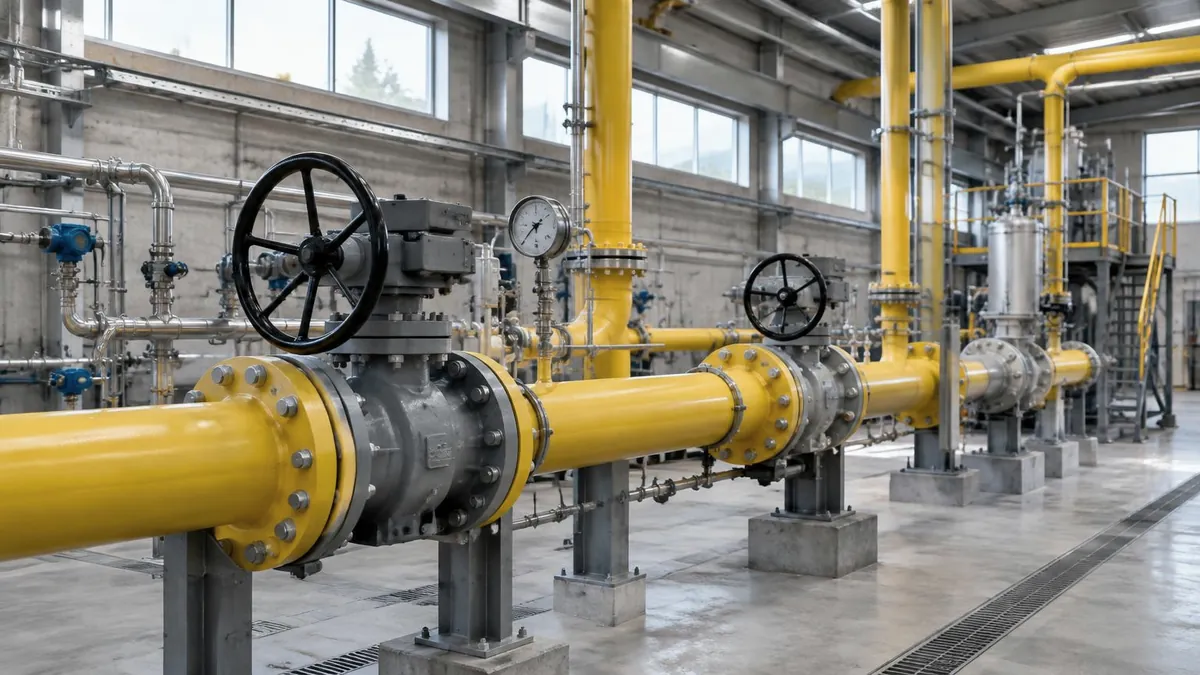
If your factory runs on reticulated gas, 2026 has changed the maths. Supply is tightening, prices are rising, and in response the Government is putting real money behind helping businesses move off gas. Here is what is on offer and how to use it.
The problem isn't going away
New Zealand's proven and probable gas reserves fell 23% in a single year, to the lowest level since records began. It is now the consensus that 12 of the country's 17 operating gas fields will stop producing within a decade, and many new supply contracts now run for months rather than years. For a manufacturer, that is a strategic risk to your business and means a core input with an uncertain price and an uncertain future.
The Government's response, announced in Budget 2026, comes in two parts: cheaper bank finance for the capital project, and co-funding for the studies that come before it.
Part one: cheaper loans for the project itself
The Gas Transition Loan Guarantee Scheme opened on 31 July 2026. The Crown takes on up to 80% of the default risk on qualifying loans, and in return banks are expected to offer lower interest rates, longer terms and easier repayment structures. Westpac, for example, is offering repayment terms of up to ten years.
The key tests are simple:
- You use at least 1,000 GJ of reticulated gas a year. That is roughly 40 times an average gas-heated household, and thousands of businesses qualify, from food processors and breweries to greenhouse growers.
- Your project cuts gas use by at least 15%. It can be energy efficiency, a switch to heat pumps or electric, electrode or biomass boilers, or heat recovery. Producing less doesn't count.
- It's a new loan, up to $50 million, from a participating bank: ANZ, ASB, BNZ, Kiwibank or Westpac.
The scheme supports up to $1.2 billion of lending and runs for three years, so there is a window, but not an unlimited one.
Part two: co-funding for the groundwork
Banks will want evidence that your project works and delivers the gas savings you claim. The Energy Efficiency and Conservation Authority (EECA) will help pay for that evidence. Depending on your annual gas spend, it can fund all of a walk-through audit (capped at $3,000), half of an options assessment (capped at $5,000), or 40% of a full energy audit or feasibility study (capped at $20,000 and $50,000 respectively).
This is where most businesses should start. A co-funded options assessment, for example, gives you a costed comparison of your realistic alternatives to gas and a recommended pathway. That is exactly the document you will later put in front of your bank.
Where manufacturers get stuck
In our experience the hard part is rarely the technology. It is everything around it:
- Electricity capacity. Electrifying process heat can mean a significant upgrade to your site's connection, and lines companies can take many months to deliver one. The loan scheme can fund connection upgrades, but it can't speed them up.
- Process temperature. Heat pumps are highly efficient for lower-temperature processes but have limits. Knowing exactly what temperatures each process needs avoids expensive mistakes.
- Production continuity. A changeover needs to fit shutdown windows and keep customers supplied.
Getting these right early is what turns a good idea into a bankable project.
How we can help you get started
Sustainability Partners can take you from your first numbers to a bankable project:
- Gas baseline: we analyse your last 12 months of gas invoices to establish your annual spend, gigajoule use and carbon footprint.
- Funding eligibility: we confirm which EECA co-funding your spend qualifies for and help you apply.
- Electrical capacity: we work with your lines company to understand what your site connection can support and what an upgrade would involve.
- Independent assessment: we compare your realistic options before you talk to equipment suppliers, so the advice isn't tied to a product.
Next step: talk to us to discover your options. Start by checking your funding eligibility in two minutes, then book a 30-minute call and we'll work through the right path for your business.
Information current as of October 2026. Eligibility is confirmed by EECA and the participating banks.